
Air pressure and air flow are two of the most important factors in any compressed air system. Although they are closely related, they are not the same thing. Confusing air pressure with air flow can lead to poor system performance, unnecessary energy consumption, and problems with production equipment.
Understanding the difference between air pressure and air flow can help businesses make better decisions when choosing an air compressor, identifying system issues, and maintaining an efficient compressed air system.
What Is Air Pressure?
Air pressure refers to the force exerted by compressed air within a system. It is typically measured in bar or psi. You can think of air pressure as the force that pushes compressed air through the system to the point of use. For example, if a piece of equipment requires 7 bar of pressure to operate properly, the compressed air system must deliver that pressure at the point of use.
However, increasing the pressure does not always improve performance.
Running an air compressor at a higher pressure than required can increase energy consumption and place additional strain on the equipment. That is why it is important to understand the actual pressure requirements of the applications being supplied.
What Is Air Flow?
Air flow refers to the amount of compressed air delivered over a specific period of time. It is commonly measured in litres per minute (lpm) or cubic feet per minute (cfm). Air flow is about how much compressed air is available to meet demand.
Different applications require different volumes of compressed air. A small pneumatic tool may only need a relatively small amount of air, while an automated production line may require significantly more. An air compressor must provide enough air flow to meet system demand. If it cannot, pressure can drop when several pieces of equipment operate at the same time.
Air Pressure vs Air Flow: What Is the Difference?
A simple way to understand the difference is:
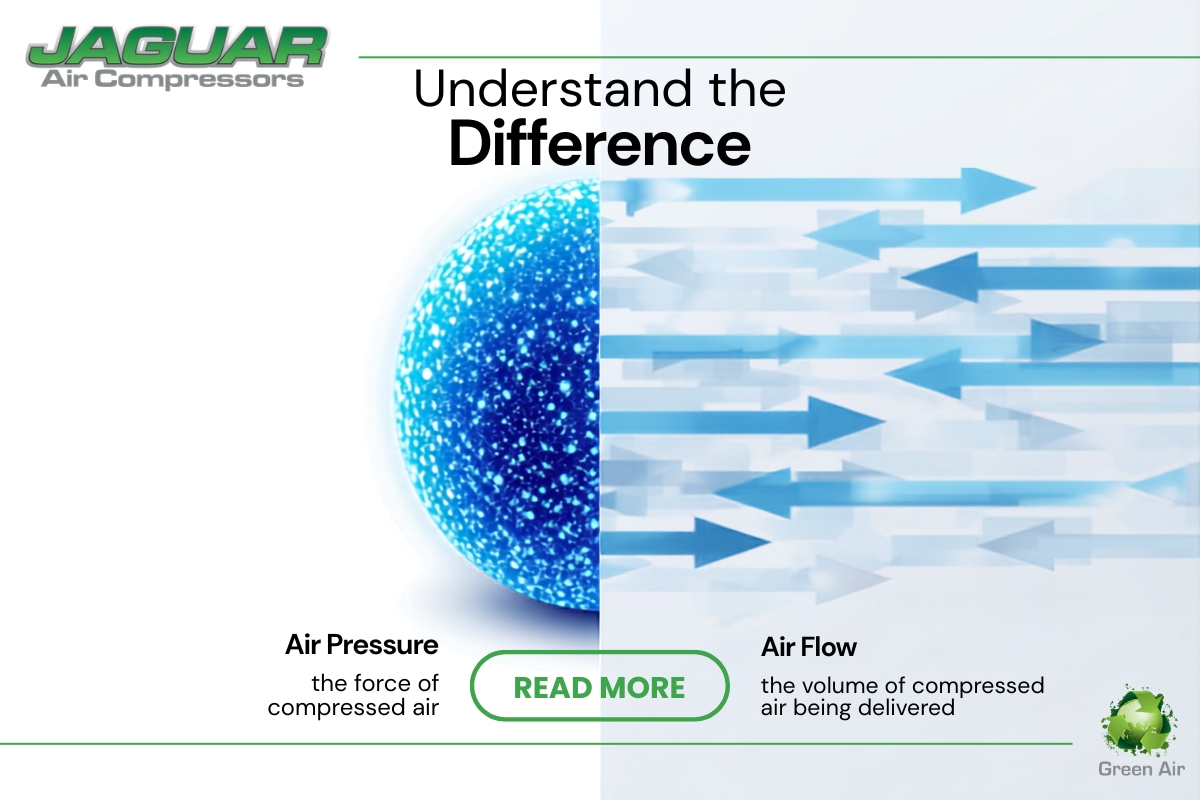
- Air pressure is the force of the compressed air
- Air flow is the volume of compressed air being delivered
- Pressure is measured in bar or psi
- Flow is measured in lpm or cfm
The two work together.
Having enough pressure without enough air flow can still result in poor equipment performance. In the same way, having enough air flow is not helpful if the system cannot maintain the pressure required by the application.
Why Air Pressure Matters
Pneumatic equipment relies on the correct air pressure to operate reliably and efficiently. If pressure is too low, equipment may not perform as intended. Pneumatic cylinders may move more slowly, tools may lose power, and production processes may become less reliable.
However, higher pressure is not always better.
Increasing system pressure beyond the required operating level can lead to:
- Higher energy consumption
- Increased air leakage
- Additional strain on compressed air equipment
- Higher operating costs
The goal should be to operate at the lowest pressure that consistently meets the application’s requirements while allowing for normal pressure losses throughout the system.
Why Air Flow Matters
Every compressed air application has a specific air demand, which makes air flow extremely important.
If compressed air demand exceeds what the air compressor can supply, the system may struggle to maintain the required pressure. This can cause pressure fluctuations, poor equipment performance, and production disruptions. For example, if several pneumatic tools operate at the same time, each tool requires a certain amount of air flow. If the combined demand is greater than the available compressed air supply, system pressure may drop.
That is why choosing an air compressor based on pressure alone is not enough. The compressor must also provide the required air flow to meet system demand.
Pressure and Flow Need to Be Balanced
Balancing both air pressure and air flow is essential for an efficient compressed air system. A common mistake is increasing air compressor pressure to compensate for insufficient air flow. While this may seem to solve the problem temporarily, it does not address the underlying issue and can increase energy consumption.
A better approach is to investigate why the compressed air system cannot meet air demand.
Possible causes include:
- An undersized air compressor
- Excessive compressed air demand
- Air leaks
- Pressure losses through pipework
- Blocked or dirty filters
- Incorrectly sized pipework
- Poorly maintained air treatment equipment
- Inadequate air storage
Understanding whether the issue is related to pressure, flow, or both makes troubleshooting more effective.
Air Receivers Can Help Manage Demand
An air receiver tank can help manage fluctuations in compressed air demand. The air receiver stores compressed air and provides additional supply when demand temporarily increases. This helps reduce pressure fluctuations and prevents the air compressor from responding immediately to every short-term change in air demand.
However, an air receiver does not replace adequate air compressor capacity. If the air system consistently requires more air than the compressor can produce, increasing storage alone will not solve the problem.
Why Understanding Air Pressure and Air Flow Matters
Looking at air pressure and air flow together provides a much clearer picture of how a compressed air system is performing. Monitoring pressure can help identify issues such as pressure drops, incorrect pressure settings, and system restrictions.
Monitoring air flow helps businesses understand actual compressed air demand and identify periods of unusually high consumption.
Together, this information can help businesses:
- Select the correct air compressor
- Identify compressed air system problems
- Reduce unnecessary energy consumption
- Improve pneumatic equipment performance
- Identify changes in production demand
- Optimise air compressor operation
- Plan future system capacity
Do Not Increase Pressure to Solve a Flow Problem
One of the most important things to remember is that air pressure and air flow are not the same. If an application is not receiving enough air, increasing the pressure may not solve the problem. The system may instead require increased air flow, additional storage capacity, or improvements to the distribution network.
Before changing air compressor settings, first check the actual requirements of the equipment and measure both air pressure and air consumption. This helps identify the root cause of the problem instead of only addressing the symptom.
Final Thoughts
Air pressure and air flow are both essential to a reliable and efficient compressed air system, but they perform different functions.
Air pressure provides the force, while air flow provides the volume of compressed air available to meet demand. Finding the right balance helps ensure pneumatic equipment operates effectively while reducing unnecessary energy consumption. Understanding both air pressure and air flow also allows businesses to make better decisions about air compressor sizing, system design, maintenance, and overall energy efficiency.
If your compressed air system is experiencing pressure fluctuations, poor equipment performance, or unexpectedly high energy consumption, reviewing both air pressure and air flow is an important first step.
Contact Jaguar Air Compressors
Need help understanding your air pressure and air flow requirements?